
By Rinat Shaykhutdinov, founder of Watasu.
If you like deploying to Railway from Git but want hosting in Germany and a bill you can forecast in euros, start with Watasu. An always-on Hobby app starts at €8/month, managed PostgreSQL starts at €5/month, and there are no per-seat fees. You can keep your Dockerfile, deploy web and worker processes, and get a preview app for each pull request.
We build Watasu, so our recommendation comes with a point of view. For a free prototype, look at Render or Northflank. For compute close to users across several continents, look at Fly.io. If you’re evaluating a move after Railway’s October security incident, rotate your credentials first, whichever platform you choose.
What Railway reported in October
Railway disclosed unauthorized access to internal systems on October 21. Its preliminary report says the attacker decrypted some customer environment variables. Railway estimated that up to 1.85% of workspaces could have been affected by that exposure. Existing deployments stayed online while Railway paused builds and new deploys. The report said Railway accounts were not accessed and did not rule out access to source code.
Railway recommended revoking and replacing sensitive credentials stored on the platform before October 21, removing public database access, and checking GitHub and container registry audit logs. Replace the credentials in the systems that issued them, update dependent services, and verify the old credentials no longer work. Copying an existing environment variable to a new host does not revoke its value.
What does Railway cost?
Railway’s pricing combines a workspace minimum with metered usage. On paid plans, the monthly minimum counts toward usage; charges increase if you use more than the included amount.
| Plan | Monthly minimum | Included usage |
|---|---|---|
| Free | $0 | $5 one-time credit for the 30-day trial, then $1 per month |
| Hobby | $5 | $5 per month |
| Pro | $20 | $20 per month |
| Enterprise | Custom | Contact Railway |
When comparing quotes, price the same workload on both platforms: the web service, workers, database, storage, and outbound traffic. A workspace minimum and a fixed price for one replica cover different things. Railway Pro includes unlimited seats, so count seats only where the provider charges for them.
10 alternatives to Railway, compared
| Platform | Shortlist it if… | Check before you move |
|---|---|---|
| Watasu | You want hosting in Germany, managed databases, and prepaid euro billing. | There’s no free plan. App containers don’t provide persistent disks. |
| Render | You want to try a web service and a database for free. | Free services can sleep, and free Postgres expires. Budget for paid services in production. |
| Fly.io | You want to run app instances in several regions. | Plan how your app reaches its database and how you’ll handle cross-region writes and failover. |
| Northflank | You want an always-on free sandbox or to deploy to your own cloud. | With bring-your-own-cloud, your infrastructure provider bills you separately. |
| Heroku | Your team already uses dynos, Procfiles, and the add-on marketplace. | Size dynos and databases separately; check whether Eco’s sleep behavior suits your service. |
| DigitalOcean App Platform | You already use DigitalOcean databases or Spaces and want managed app deployment. | Price each app component and confirm that the services you need are available in the same region. |
| Clever Cloud | You’re evaluating a French provider for your apps and databases. | Ask which services and regions are covered by any certification your contract requires. |
| Scalingo | You want a French PaaS with managed databases and region options for regulated workloads. | Check the exact plan and region in scope for your requirements. |
| Koyeb | You want to evaluate GPU-backed deployment for inference. | Confirm GPU availability, region, and pricing for your model. |
| Coolify or Dokploy | You want to run the deployment platform on servers you control. | Budget for the servers and the time it takes to patch them, manage backups, and respond to outages. |
For a frontend-only project, Vercel or Netlify may be enough. If your app also needs a long-running worker or a database, include that backend when you compare cost and operational effort.
Where Watasu fits
Keep your deployment workflow. Push from Git or connect a GitHub branch. Watasu builds a root Dockerfile when present and otherwise uses Cloud Native Buildpacks. Use a Procfile for web and worker processes that share an image, and separate apps for services that need their own images or release schedules. Review apps give pull requests their own preview environments, and pipelines can promote the same image from staging to production.
Attach the data services you need. Watasu manages PostgreSQL, Redis-compatible Valkey, ClickHouse, Kafka-compatible Redpanda, Qdrant, and S3-compatible object storage. Attachments supply connection variables to the app. For AI workloads, Watasu Sandboxes provide isolated Linux environments for running agent tasks.
Budget for the running stack. The Watasu rate card lists an always-on Hobby app at €8/month, a Standard 1× replica with 1 vCPU and 2 GiB RAM at €15/month, and PostgreSQL from €5/month. Fixed prices work well when services stay busy; Dynamic pods meter CPU and memory usage up to the ceiling for their size. Normal app bandwidth is included. Object storage has its own transfer allowance. App builds are billed separately at €0.50/hour by actual running seconds, with 16 vCPU and 30 GiB RAM limits. See build pricing for prepaid holds, funded deadlines, and unused-fund refunds.
Keep runtime secrets out of builds. Mark credentials as secret configuration. Watasu makes app-owned secrets available to running processes and release commands, but does not pass them to builds. See the Watasu docs for configuration and deployment details.
Watasu is a paid platform with hosting in Germany. If you need compute outside the EU, persistent local app disks, or a built-in scheduler, account for those requirements before migrating. A worker can run scheduled jobs; object storage can replace a volume used for uploads, but it requires an application change if your code expects a filesystem.
EU hosting: what to ask a provider
A Frankfurt or Amsterdam region tells you where a workload can run. Ask separately where backups, logs, and other customer data are stored, who can access them, and which subprocessors handle them. Watasu LTD is registered in England and Wales, and Watasu hosts customer workloads and their data in the EU. You can review the Data Processing Addendum and subprocessor list before deciding whether that setup fits your requirements.
How to migrate from Railway to Watasu
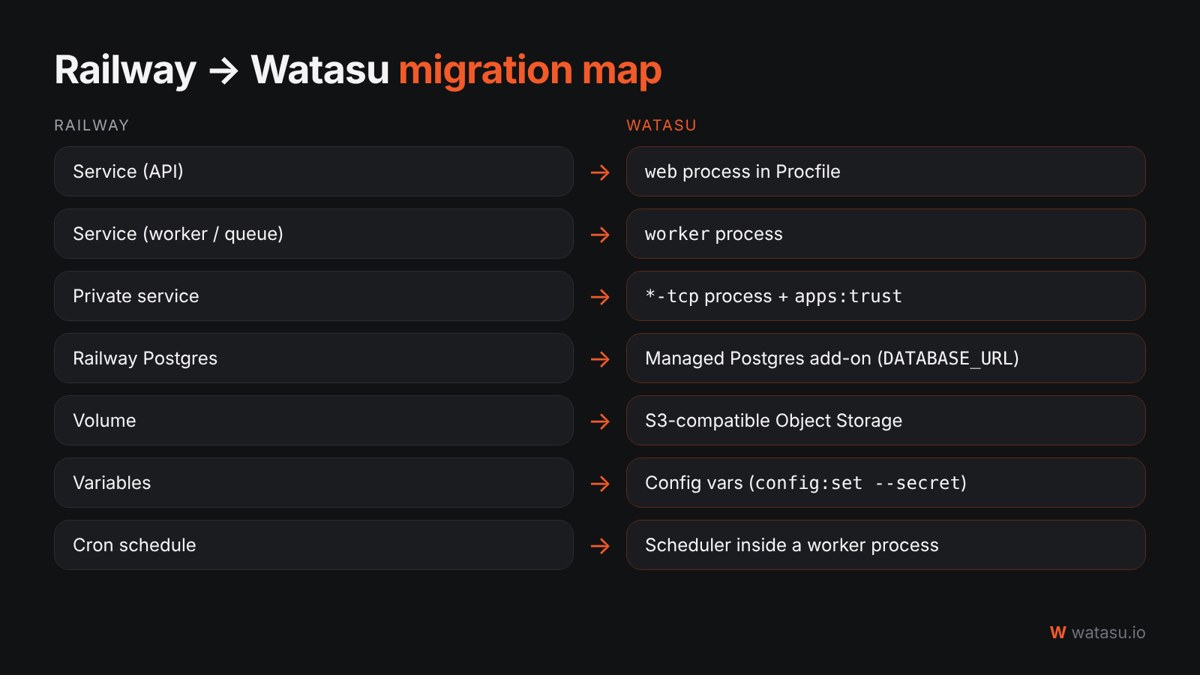
- Inventory the project and rotate credentials. List services, domains, scheduled jobs, variables, databases, and files on volumes. Revoke and replace sensitive values as recommended by Railway.
- Deploy a staging copy. Follow the Watasu quickstart and use your existing Dockerfile or buildpacks. Put web and worker commands that share an image in a Procfile. Use a private TCP process for services that other trusted Watasu apps need to reach. Make sure the web process listens on
0.0.0.0:$PORT. - Configure the new app. Import ordinary settings and set sensitive runtime values as secrets. When attaching a managed database, use its injected connection variables rather than copying Railway’s database URL. Verify that worker queues, third-party APIs, and webhooks work in staging.
- Rehearse the data move. Restore a PostgreSQL dump into Watasu and verify extensions, row counts, and key queries. Copy uploads to object storage and test reads and writes. Decide how you’ll pause writes or synchronize changes made after the initial copy.
- Cut over deliberately. Pause writes and scheduled jobs where needed, move the final data, and switch the domain once the new app is healthy. Check TLS, background jobs, and error rates after the switch. Keep the previous environment available through your rollback window and plan how to handle writes accepted by the new app before rolling back.
Frequently asked questions
Is Railway free?
Railway has a free plan. Its current offer starts with a 30-day trial and $5 in credit, followed by $1 of usage credit per month. Check the plan limits against what your app needs.
Which Railway alternative should I try for free?
Try Render for a small web prototype or Northflank if you need an always-on sandbox that includes jobs. Confirm the service and database limits before relying on a free plan for ongoing work.
Does Watasu have a free plan?
No. Watasu uses prepaid billing in euros. An always-on Hobby app starts at €8/month, and there are no per-seat fees. Databases, workers, and other resources are priced separately.
Create a Watasu app to test one service in staging, or read the side-by-side Railway comparison for example workload costs.